

You just don’t seem to “click” with this new manager. Or despite trying different tactics you just can’t seem to connect with your teenager. All of us have been in some version of this dynamic both at work and home.
Invariably this leads us to try and “get better at communication”.
Unfortunately, most communication advice focuses on tactics: phrase things differently, structure arguments better, and so on. These are then followed up by prescriptions. Now they have AI software that supposedly makes you a better manager/leader by giving you situational scripts. Parenting is probably next (which makes me shudder).
There’s clearly value in this. But they also miss something.
The assumption is that communication is primarily about what you say and how well you say it. “If I can just find the right words”, we think.
But anyone who has delivered a well crafted thoughtful message also knows another strange reality: you can say something that’s perfect on paper and still miss, or worse backfire. Conversely, you can say something clumsy or incomplete, but the other person still gets it.
So what’s going on here?
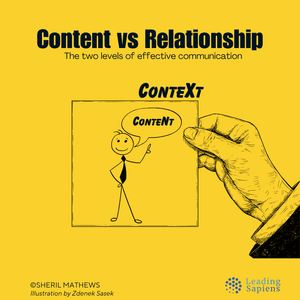
Human interactions operate on two levels at once. One level carries “content” — the issue at hand. But content sits within another level called context or “relationship” — what the interaction implies about authority, trust, and alignment.
We spend all our energy polishing the visible layer of content. However the real issue is often one level higher in relationship/context.
This distinction — between content and relationship — is key to understand why we fail to connect. In my experience, focusing on the relationship level is a higher ROI skill than trying to script the perfect message.
It’s also another reason why AI is not going to replace a human anytime soon — based on where and how you are adding value. AI doesn’t have “judgement, feel, or taste” — skills that will increase in importance and value as AI infiltrates and commoditizes all aspects of work.
The Two Levels of Communication
Human communication is built on a structural split that’s easy to overlook. Every message contains two elements. Paul Watzlawick called them the “content” and “relationship” levels of communication. [1]
Content level is straightforward. It’s the literal message: the data, the explanation and so on. It’s the part that can be true or false, reasonable or unreasonable. This is the layer we spend all of our time improving because it’s visible and lends itself to technique. Better phrasing and clearer logic belong here.
But there’s a second layer that sits on top of content. It’s the context or relationship level that classifies how to interpret that message. Context operates at a higher logical level than content.
When you say “We should revisit the plan”, the words are clear. But the message can also be interpreted as “I don’t trust your judgement,” “I’m stepping in,” or “I’m taking control back.” You think you are offering help, but the other sees it as scrutiny.
Context is implicit and answers a very different set of questions:
- Is this collaborative or evaluative?
- Are you giving me a suggestion or a directive?
- Are we aligned or in conflict?
- Who has authority here?
These questions are rarely asked directly, but they are pivotal in how others perceive us.
The same words can function as guidance, criticism, invitation, or dismissal depending on the relational logic surrounding them. The relationship level in effect frames content.
When the relationship level is healthy, context is invisible because the “meta-communication” is consistent. You don’t have to wonder whether a remark was meant as criticism or curiosity because know how to read it. But in more fragile situations — new relationships, ambiguous roles — the context layer is unstable, and small signals take on disproportionate weight.
Once you see communication in these two layers, many otherwise confusing interactions start to make more sense.
When interacting with human beings, we aren’t just exchanging information, but also negotiating how we relate to each other. No amount of content-level refinement can fix a context-level mismatch.
Interactions morph into set patterns
To make matters worse, or rather sticky, Watzlawick notes how over time communication between two people evolves into patterns — what he calls "ongoing interaction systems". Systems is the key word here. [1]
The relationship level is not created in any single conversation but something that stabilizes over time. Repeated interactions create expectations. As one person pushes, the other becomes cautious. These sequences repeat, and gradually they become the “normal” way two people communicate.
Once set, new messages are interpreted through that established pattern. Even neutral statements get pulled into it. A suggestion comes across as criticism because suggestions have usually functioned that way before.
This is why misunderstandings feel persistent. You resolve one issue, but the same conflict reappears in another form. The content changes, but the pattern remains intact.
That’s why, communication problems are rarely just about what was said. They are features of a pattern. And unless that pattern changes, changing content alone typically has limited effect.
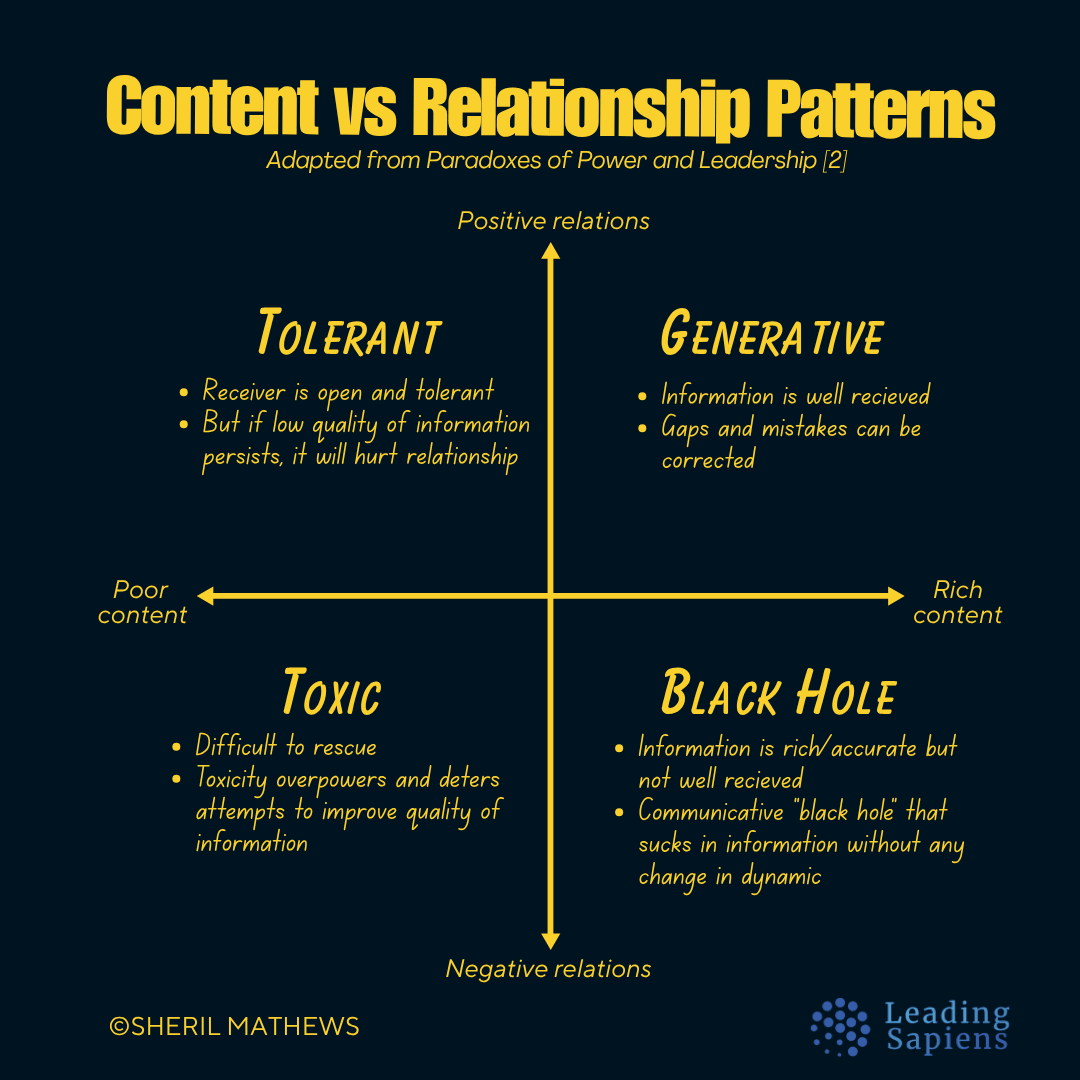
See if you can identify the pattern you are currently in:
The comfort of content
Before jumping into how to get better at the relationship level it’s worth asking: why do we spend nearly all our efforts at the content level?
For one, content is explicit. It’s the part of communication that feels concrete, controllable, and safe. You can point to it, edit it, measure it. We can be “right” at the content level. Organizations reinforce this orientation by rewarding clarity, logic, and precision. Entire industries of communication training are built on content-level improvement. They create the appearance of progress by focusing on the visible layer of the exchange.
Context, by contrast, is nuanced and sits in assumptions about power, trust, and identity. It’s more “squishy”. Working at the context level means acknowledging difficult questions: Whose interpretation carries weight? What is being negotiated?
Focusing on content lets us avoid confronting how we are being perceived. It gives something to work on without us having to confront the underlying dynamics. If a conversation goes poorly, we can treat it as a matter of misunderstanding rather than a signal about the relationship itself. It’s more comfortable to believe that “they didn’t get the point” than to consider how our own role, status, or behavior made things harder.
Finally, content is plain simpler. Processing the relational logic requires attending to two levels simultaneously: the literal message and the meta-message. We collapse these levels because the brain prefers a single, coherent narrative. It’s easier to argue over the stated issue than to track the unwritten rules actually shaping the interaction.
Markers of the relationship level
The relationship level sounds abstract, but in practice it’s quite concrete. It consists of a handful of signals that define how the interaction should be understood. Paying attention to these six markers in itself can drastically improve your communication.
First there’s role. Every conversation implicitly answers the question: who is speaking from what position? Are you advising, evaluating, or collaborating? A suggestion from a peer is heard differently than the same suggestion from a manager. While the org chart might dictate a certain role, within a given situation there’s a range of roles you can assume.
Next is inferred intent. Is there alignment between your intention and how the other sees it? You may intend to explore options, but if the interaction feels evaluative, your questions will be heard as tests.
Then there’s alignment. Does it feel cooperative or adversarial? When alignment is assumed, we tolerate ambiguity and incomplete information. But when uncertain, even precise statements are scrutinized. The content hasn’t changed but the willingness to interpret it generously has.
The fourth component is authority and autonomy. Conversations often implicitly negotiate who has decision rights and how much independence exists. A request for input can be heard as consultation or as oversight depending on how authority is perceived. This is why the same conversation can feel empowering in one context but constraining in another.
Then there is trust. In high-trust relationships, even blunt statements are interpreted charitably. In low-trust relationships, neutral comments can be examined for hidden implications.
Finally, there’s history because past interactions accumulate. If previous conversations involved scrutiny, new questions are heard the same way. If earlier exchanges were collaborative, the same questions will feel supportive.
Taken together, these elements form the relational context. They define the “rules” of the interaction. Once those rules are inferred, the content is interpreted within them.
Getting better at the relationship level
If the relationship level shapes interpretation, and interaction patterns reinforce themselves, the obvious question is: how do we get better at working with this layer?
First, pay attention to how the conversation is progressing, not just what’s being discussed. Most of us track the topic but aren’t alert to whether the interaction is becoming evaluative, collaborative, defensive etc. These changes often happen long before things breaks down. By noticing them early, you have more room to adjust.
Second, treat reactions as data about the relationship, not just responses to content. If a neutral question produces defensiveness, it’s telling you something about the relational dynamic. If additional explanation does not reduce resistance, that too is information. Instead of refining wording, pause and ask what the interaction is signaling.
Third, look for recurring sequences. Watzlawick’s emphasis on interactions as systems suggests that what matters more is not isolated exchanges but patterns over time. If conversations repeatedly follow the same trajectory you are stuck in a relational loop. Recognizing it is the first step to changing it.
Fourth, clarify the type of conversation you are having. Tensions typically arise from assuming different frames. You think the discussion is exploratory, but the other thinks it’s evaluative. Identifying it explicitly — “Let’s explore options before deciding” — can change the relational context and reduce friction.
Fifth, stay alert to how roles are implicitly defined. Are you seen as an evaluator or advisor? Are you pushing them into a defensive position without intending to? Small changes in stance — inviting input, acknowledging uncertainty — can alter the tone without changing content.
Finally, recognize when improving content is no longer helping. This is often the clearest signal that the issue is at the relationship level. When more clarity, additional data, or detailed explanations do not change the interaction, it’s usually because the relational frame is broken.
In closing
Getting better at communication is more than just following prescriptive scripts. The hard work is in developing “sensitivity to interaction” aka sensemaking. Instead of “What should I say?” a better question is to zoom out: “What’s transpiring here?”
The words of course matter. But what happens in the space between the words often matters more.
Related Reading
 Sheril Mathews
 Sheril Mathews
 Sheril Mathews
Sources
- Pragmatics of Human Communication by Paul Watzlawick, Janet Beavin, Don Jackson
- Paradoxes of Power and Leadership by Miguel Pina e Cunha, Steward Clegg, Armenio Rego, Marc0 Berti