

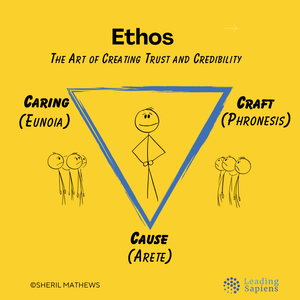
In leadership, your persuasiveness is contingent upon one question people are always asking: Can I trust the person behind the message? That’s the key idea behind the ancient Greek concept of Ethos.
Originally meaning "habitat" or "character," Aristotle considered ethos, or the appeal to credibility, as the "first among equals" in the triad of persuasion.
If you’ve ever wondered why your best ideas are ignored or why your team seems to be working for the weekend rather than your mission, the answer likely lies in your ethos.
Character contains almost the strongest proof of all.
— Aristotle [1]
Persuasion is achieved by the speaker’s personal character when the speech is so spoken as to make us think him credible. We believe good men more fully and more readily than others: this is true generally whatever the question is, and absolutely true where exact certainty is impossible and opinions are divided. This kind of persuasion… should be achieved by what the speaker says, not by what people think of his character before he begins to speak.
… his character may almost be called the most effective means of persuasion he possesses. [1]
👋 Get my new articles in your inbox 👇
Aristotle’s Ethos
There is no stronger test of a man’s real character than power and authority, exciting as they do every passion, and discovering every latent vice.
— Plutarch
Given how power changes leaders, people are naturally wary of those in authority. That’s why Aristotle argued that while logic and emotion are powerful, "character contains almost the strongest proof of all".
He identified three elements of Ethos:
- Phronesis (Practical intelligence): The audience must believe the speaker has the expertise, common sense, and street smarts to solve the problem at hand.
- Arete (Virtuous character): You show that you share the audience's values and standing for a cause larger than oneself.
- Eunoia (Goodwill): The audience must feel the speaker is on their side, acting with their best interests at heart, not for personal gain.
Jay Heinrichs calls these the 3 Cs: Craft (phronesis), Cause(arete), and Caring(eunoia).
Only when all three are present are leaders seen as trustworthy.
1. Phronesis (wisdom and craft)
They should rule who are able to rule best.
— Aristotle
Often translated as "prudence" or "competence”, Phronesis is showing that you actually know what you’re talking about. It’s the street smarts of leadership. In uncertainty — where a future course of action must be chosen — everyone’s primary concern is: Will this work?
Without Phronêsis, people may believe you are genuine but will ultimately doubt your ability to navigate complex challenges. Competence is the foundational layer of trust; without it, character is seen as well-intentioned but useless.
This is why Aristotle emphasizes that an effective orator—the ancient equivalent of a political or business leader—must have exhaustive knowledge of their subject, whether it be revenue, foreign policy, or trade.
Heinrichs calls this first pillar of phronesis as Craft. You display craft by focusing on experience. This is why political candidates often tout their backgrounds as businesspeople or doctors because competence is inherently persuasive.
“It depends” signals craft. A one-size-fits-all solution is typically viewed with suspicion. In contrast, those who ask about the specific nature of a problem before offering a tailored solution are considered practically wise.
2. Arete (integrity and cause)
While Phronêsis shows your ability, Arête, or "virtue", is about reliability.
Virtue here does not mean being a paragon of morality. It means people trust that your intentions and values are aligned with theirs, rather than what’s merely self-serving. You become rhetorically virtuous by embodying the "us" of the organization.
Heinrichs calls this "Cause" : you stand for something larger than yourself that the audience also values. This is why values are critical to effective leadership. You build trust by upholding shared beliefs and attitudes.
However, virtue is also subjective. What is considered virtuous by a group of tech entrepreneurs might be seen as reckless by a board of conservative educators.
The key to virtue is finding the "Golden Mean"— the sweet spot between two extreme values. A virtuous soldier is neither a coward nor foolhardy; they are courageous — the mean between the two.
Modern leaders must navigate this tension daily: staying true to yourself while being agreeable enough to retain the power of influence.
3. Eunoia (unbiased and caring)
The final pillar is eunoia, or "goodwill." This is the "caring" component of leadership. It’s the projection of a "disinterested" perspective — showing that you have no personal bias or interest that conflicts with their well-being.
A leader shows eunoia by making the audience feel like their interests are the leader’s top priority. You can use the "reluctant conclusion": show that you’re making a decision only because the evidence is so strong, and it’s in their best interest, even if it seems to cost you personally. People see you as a partner in their success, rather than a manipulator with a hidden agenda.
Historically, this was so important that the American founders often published their political arguments anonymously. They didn't want readers to think they were arguing for their own gain. Those who can honestly say, "I am doing this because it is best for us, even though it will be difficult for me," earn a different level of trust.
In modern terms, this is the "servant leadership" model, where the leader is a benefactor whose primary motivation is the beneficiary’s advantage, not their own.
Some characteristics of Ethos worth noting
The art of fitting in
Ethos is closely linked to decorum: meeting people’s expectations for tone, appearance, and manners. The word ethos originally meant "habitat" — just as a penguin fits the habitat of an iceberg, a speaker must fit the mental "habitat" of their audience.
You persuade a man only insofar as you can talk his language by speech, gesture, tonality, order, image, attitude, idea, identifying your ways with his.
— Kenneth Burke [3]
Decorum isn't about being "polite" but gaining a sense of group identity. This is why a politician might trade a suit for a flannel shirt when speaking to a rural community. It says, "I am one of you".
Credibility isn’t pre-ordained
A common misconception is that Ethos is simply your "reputation"—the things people say about you before you enter the room. While a pre-existing reputation certainly helps, rhetorical Ethos is technically something you achieve during the act of communication.
Aristotle emphasized that even a person with a stellar background must re-establish character through what they say and how they say it. This is empowering: character in an argument is not just based on your past, but a performance you can start afresh in every meeting.
This "achieved" character is what allows a newcomer to win over a skeptical board, or a manager to pivot and regain trust after a failure.
Congruence is persuasive
True credibility requires consistency between internal reality and external expression — the alignment of thought, speech, and action. When a leader "walks the talk," they produce a sense of "constancy" that builds confidence.
Carl Rogers, the pre-eminent psychologist of the 20th century, called this “congruence”.
This alignment is an antidote to "empty speech" or "idle chatter," which Aristotle dismissed as the product of "uneducated" or "base" minds. Leaders who are disconnected from their beliefs — aka "doublespeak" — eventually destroy Ethos because people can sense the lack of alignment.
Adapt your style
While the core components of Ethos are universal, Aristotle was a pragmatist who recognized that the "performance" of character must suit the specific "genre" and audience.
Addressing a formal assembly requires a different style than when speaking in a courtroom or a ceremony. Effective leadership involves "choosing the most persuasive and evocative language" to fit the moment — what the Romans called propriety.
Aristotle’s lesson is that there’s no single correct personality for leadership, but rather a correct way to align your natural style with the virtues of clarity, appropriateness, and truth.
Perfect isn’t as convincing as we think
We often think that to be persuasive, we must be flawless. But perfection can actually be a liability. When you are too polished, correct, or slick, others become suspicious of your motives.
The ancients suggested a counterintuitive tool: dubitatio. It means showing a certain amount of helplessness or uncertainty. This way you lower the audience's expectations and convey a sense of sincerity.
Abraham Lincoln was a master of the country-bumpkin image. His seemingly unpolished delivery disguised a brilliant analytical mind, but it was his Ethos — the perception of him as an honest, plain-spoken man — that made his brilliant logic so much more acceptable to the masses.
Revealing a "tactical flaw"— a noble mistake or a humanizing weakness — can win a level of sympathy that a perfect performance never could. For more on this, see self-disclosure.
Handling blunders
Give me a fruitful error any time, full of seeds, bursting with its own corrections. You can keep your sterile truth for yourself.
— Vilfredo Pareto
The ultimate test of credibility is how you handle blunders. Our instinct is to get defensive or offer a generic apology. However, savvy leaders use mistakes as genuine opportunities to build ethos.
When you screw up, you must be first with the news. Affirm arete by acknowledging that you failed to meet your own high standards. But also switch the focus to the future. Instead of dwelling on the past, outline the choices ahead. Focus on phronesis by showing you know how to resolve the problem. Then demonstrate eunoia by dropping everything to get it right. 3
By focusing on values and clear actions to fix the mess, you come out more trustworthy than you did before the error.
In closing
As you reflect on your communication, ask:
- Can they see my craft: evidence that I can solve this specific problem?
- Is my cause clear: shared values that make me "one of them"?
- Do I show my caring: disinterestedness that proves I am acting for their sake?
True credibility is not something you "have" based on your resume, but something you "perform" by balancing these three pillars in the eyes of those you seek to move.
Related Reading on Ethos
 Sheril Mathews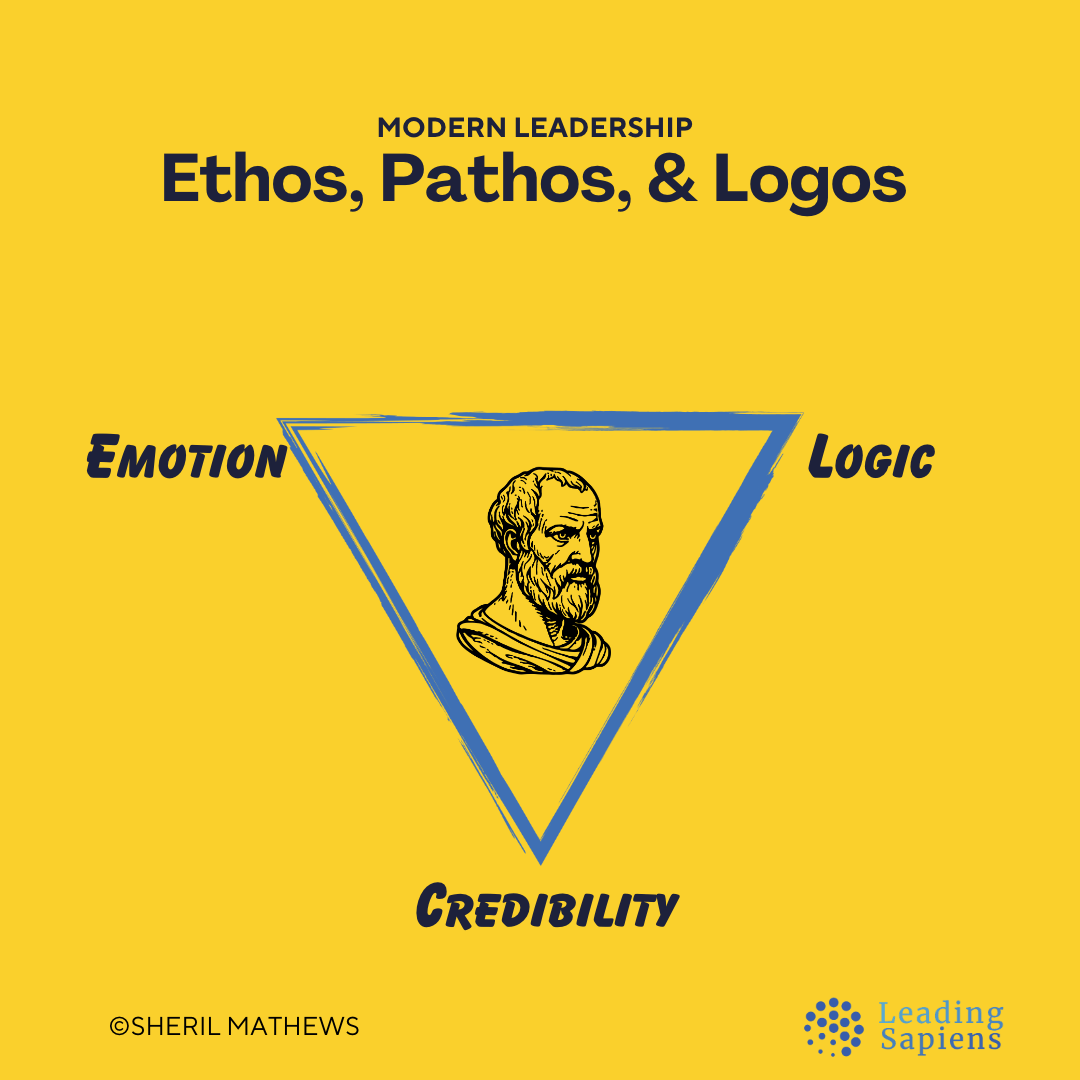
 Sheril Mathews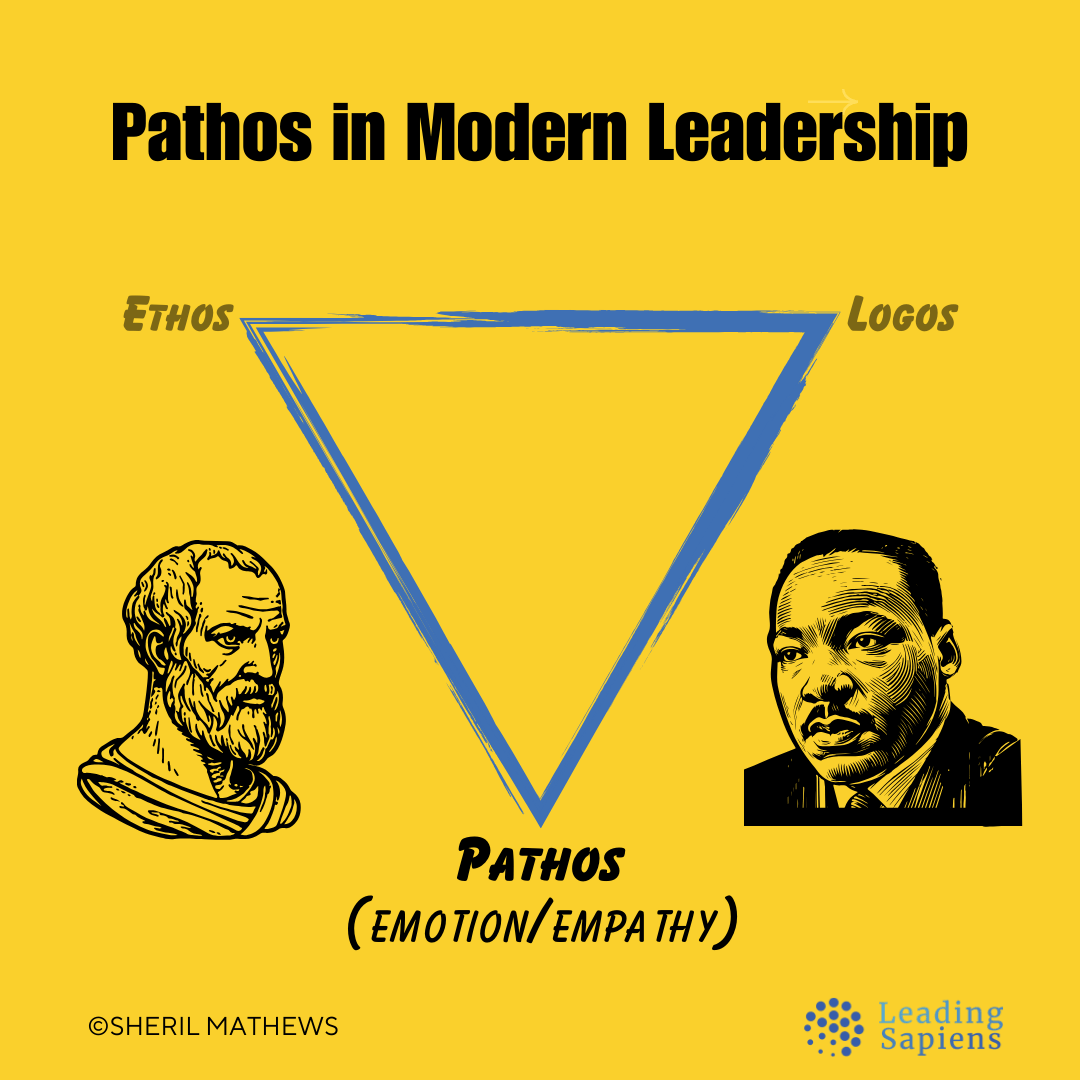
 Sheril Mathews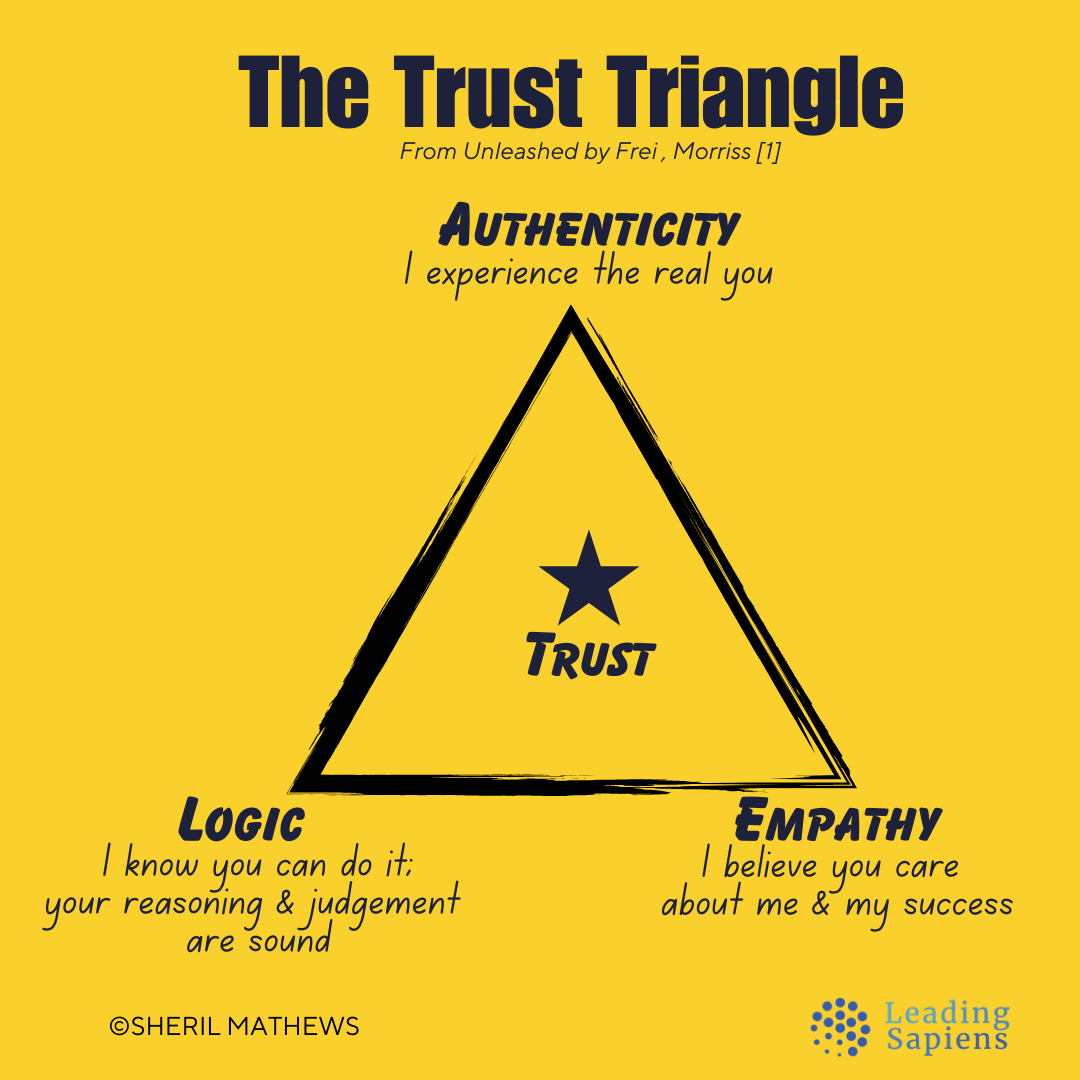
Sources
- Aristotle, The Art of Rhetoric
- Christof Rapp, "Aristotle’s Rhetoric," Stanford Encyclopedia of Philosophy, 2022.
- Jay Heinrichs, Thank You for Arguing
- Stephen J. Costello, Between Speech and Silence: From Communication to Meditation.