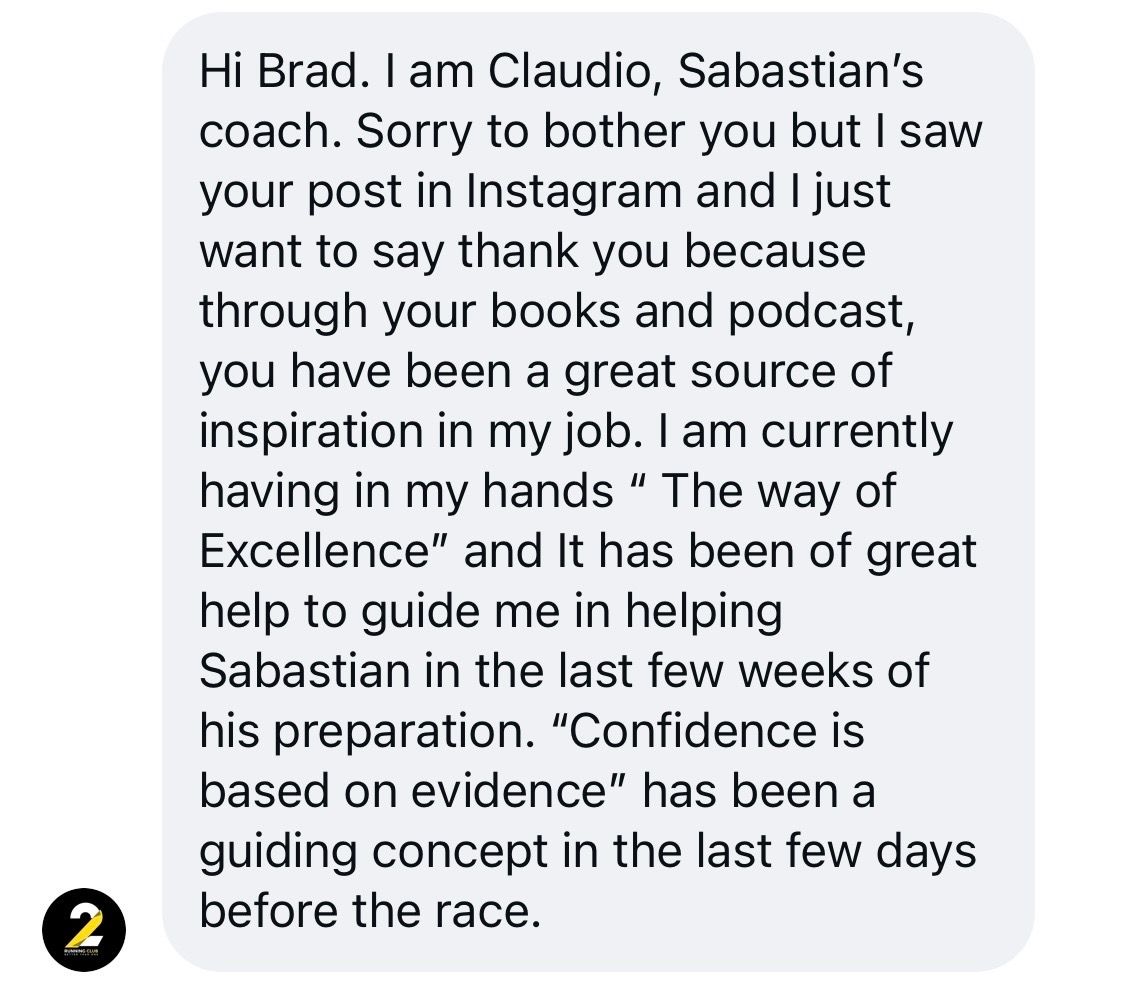

If you follow sports, you probably heard the news of Sabastian Sawe's superhuman feat of becoming the first person ever to run a sub 2-hour marathon. Following the win, Sawe’s coach sent a note to Brad Stulberg that ended saying: "Confidence is based on evidence” has been a guiding concept in the last few days before the race. [4]
He was referring to Stulberg’s latest book, The Way of Excellence. In it, Stulberg writes,
….Underneath confidence you’ll almost always find evidence.
No amount of outward bravado compensates for a lack of inner evidence. Even approaches like self-talk only work if you have reason to believe what you are saying. There is only one way to gain genuine confidence: by doing the work to earn it.
The more reps we put in, the more faith we gain in our respective endeavors, and in ourselves. It is not blind or delusional faith. It is faith based on a concrete body of evidence, which is a powerful way to think about confidence.
Confidence comes from evidence.
Stulberg’s emphasis on evidence draws on the research of Albert Bandura, who studied the often vague notion of confidence — what he called self-efficacy. Bandura’s work found “mastery experiences” — or Stulberg’s evidence — the strongest source of efficacy.
Doing, in other words, is the best persuader.
In my formative years, not understanding some basic mechanisms of how confidence and doubt operate, I wasted a lot of time and effort chasing the “feeling” of confidence.
I wish I’d known/understood two aspects in particular:
- Confidence cannot be pursued; it can only ensue. What can we pursue instead? A body of work (evidence) that ensures confidence follows naturally.
- Doubt will inevitably arise and is unavoidable. The skill is in changing WHAT we doubt.
Let’s take a closer look at each of these.
👋 Get my new articles in your inbox 👇
Chasing confidence vs. building evidence
(1) Evidence is not just a support for confidence, but is the cause of confidence.
As important and critical it is to great outcomes, confidence is usually the wrong place to start. It’s rarely the clean starting point we imagine it to be. Rather, it emerges after repeated contact with difficulty has taught us something about ourselves. Once you see confidence as an effect rather than a prerequisite, the whole problem definition changes.
(2) You can artificially inflate confidence, but evidence has to be earned.
Evidence can’t be faked, and we intuitively know this. “That was hard, but I got it done” does far more for confidence than a thousand self-affirmations.
(3) Confidence, while real, is also unstable.
It can change with sleep, fatigue, a recent setback, or internal weather. You feel capable on Tuesday, but not so much on Thursday. Nothing essential has changed in your ability per se, but perception has. This is one reason confidence is a poor object of direct pursuit. You can’t always command it.
Evidence is different because it leaves a trace. Rather than moods, it’s built on data points. And our minds treat data differently from vague aspirations.
(4) Smaller tasks instead of bigger selves.
Confidence advice often focusses on inflating ourselves: believe harder, think bigger, visualize success etc. That has its place, but it can also feel hokey and empty.
Genuine confidence is built the opposite way: reduce the task until action becomes possible. Move the focus away from yourself and instead focus on what needs done.
Inflating ourselves also makes it psychologically expensive. It turns “I need to give a great presentation” into “I need to prove I deserve this.” That destroys self-efficacy because the task is no longer just a task but a referendum on identity.
Instead, “This is one rep” shrinks the identity load. And it’s a lot easier to grow when we’re not constantly on trial.
(5) Appearing confident and internal fortitude are not the same.
Organizations regularly reward the performative version of confidence: speaking loudly, sounding certain, or hiding doubt. Impression management is obviously important, but it also comes with a steep price when overdone.
There’s an ocean of difference between trusting yourself and trying to appear unshaken. The facade of the second is expensive and takes a toll with time.
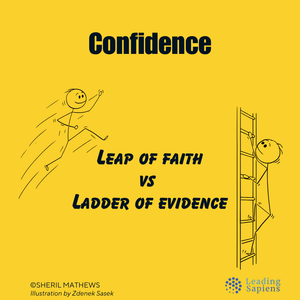
(6) Instead of a leap of faith, build a ladder of evidence
Popular culture loves the notion of a “leap of faith”. We intuitively know this is often far-fetched and impractical — and maybe that explains the infatuation with it.
In practice, though, it’s wiser to build a “ladder of evidence” instead. Or to be more specific, a ladder of tasks of increasing difficulty. How can you practice in environments of increasing stakes instead of jumping straight to the main event?
(7)“Outcome failure” is not the same as “agency failure”.
Failures don’t always mean a lack of competence, or even a lack of progress. You can make the wrong call and still have used a better decision process.
In setback (and success), it’s useful to keep the following separate:
- Outcome: What happened?
- Process: How did I go about it?
- Agency (control): Which of my actions were actually causal?
The more mature form of confidence is not certainty in outcomes, but rather trusting our ability to operate effectively in uncertainty.
(8) Fortitude is more robust than confidence.
It’s natural to want confidence that we’ll perform well. But it's even more useful to think, “I’ll recover even if I don’t do well”.
Things rarely go per plan. A mature fortitude reduces the terror of imperfection. We no longer need the situation to go perfectly because we have the resourcefulness to adapt and respond.
(9) Instead of changing personality, increase repertoire.
We imagine confident people having a certain kind of personality: bold, expressive, dominant, or charismatic.
But real confidence — aka self-efficacy — is repertoire-based and domain specific.
We don’t have to upgrade our personalities. What’s needed instead is a wider range of practiced behavioral repertoires in a given context. Instead of waiting for a feeling (confidence), practice the behaviors that produce it instead.
Doubting the doer vs. doubting the work
Building evidence inevitably means pushing the limits, which also comes naturally coupled with doubt — that pesky fellow traveler on the path to mastery who somehow shows up wherever you are.
The mistake is trying to avoid it or using it as some sort of negative indicator of competence.
Instead of trying to get rid of doubt, change WHAT you doubt.
In The Creative Act, grammy winning producer Rick Rubin writes,
It’s worth noting the distinction between doubting the work and doubting yourself. An example of doubting the work would be, “I don’t know if my song is as good as it can be.” Doubting yourself might sound like, “I can’t write a good song.”
These statements are worlds apart, both in accuracy and in impact on the nervous system. Doubting yourself can lead to a sense of hopelessness, of not being inherently fit to take on the task at hand. All or nothing thinking is a nonstarter.
However, doubting the quality of your work might, at times, help to improve it. You can doubt your way to excellence.
“Doubting yourself” is global, imprecise, and non-actionable. In contrast, “doubting the work” is local, specific, and tangible enough to work on.
Doubting the work creates distance between the doer and the doing, which gives us a fighting chance. But if I am “broken” myself, how will I fix anything? There’s no breathing room between me and the problem.
The practice is to focus doubt on the specifics of evidence. Catch yourself before it goes too global and turns into doubting yourself.
Related reading
Over the years, I’ve tackled the topic of confidence from different angles:
- Do leaders have to be confident?
- Self-efficacy: A better construct than confidence
- Being ok with doubt
- The psychology of small wins
Sources
- The Way of Excellence by Brad Stulberg
- The Creative Act by Rick Rubin
 Steve Magness
 Brad Stulberg