

Recently, a client asked for a book recommendation on leadership. I asked what problem she was trying to solve. Leading effectively is one thing. On the other hand, if she aimed to get ahead in the career game, leadership is only but one of many factors.
The problem with run-of-the-mill leadership books is that:
- They focus too much on traits and characteristics of so-called “great leaders”. To make things worse, it makes you think that effective leaders are innately that way or that it requires a special set of skills you can never master. Sure, it’s not easy, but focusing too much on traits misses the point.
- Too many of them give moral sounding prescriptions on how great leaders “should” be. Equally, “managers” are second class citizens vilified as necessary but evil twins.
- Sometimes, it’s one person’s perspective, or revisionist takes (think CEO biographies) that worked for them but doesn’t translate well to our unique situation.
- Many ignore the reality of what people face in the workplace. You read one of these and end up even more disenchanted with the disconnect between what they propose and the dysfunction you see daily.
The good news is that there are, in fact, good ones — although few and far in between — that give you a meta-framework to operate effectively amidst these otherwise imperfect conditions.
One of those is Rob Goffee and Gareth Jones’ Why Should Anyone be Lead by You? In this piece, I share a snippet from it. To preserve pithiness, I haven’t added much commentary. I have, however, connected it to my previously published articles that build on these ideas.
This is a first in a series on books, both leadership and otherwise — many unknown, others forgotten — that I’ve found useful in my work. While not a summary, these pieces will introduce you to key ideas along with books I highly recommend.
Let’s jump in.
In search of formulas
So why are leadership prescriptions so abundant and popular? For one, it’s easier to package and sell traits as a formula. It’s much harder to tell someone — or an entire corporation — that “it depends” and that it will take reflection, time, and effort.
The reality is that there’s no one straightforward answer, neither are there proven formulas that work everywhere. As is often the case, it’s more nuanced than we’d like to think.
There are no rules for human behavior that apply in every situation without limit or change. Humanity yearns for certainty; it has looked for such rules for thousands of years but has not found them. For every principle it has discovered, it has also discovered a conflict of principles. In recent years men of practical affairs—industrial executives, for instance—have often come to psychologists and sociologists begging for a plan or set of rules that the executives can apply “across the board”— that is, in all circumstances—in dealing with their employees.
There are no such rules, and if there were, they would be dangerous. They might work well for a time; then changing circumstances would make them inappropriate, and the leader would have to deal with a new situation while his mind was clogged with old rules. The maxims of leadership we shall state are, therefore, not to be taken as absolutes but only as convenient guides for the behavior of a leader. They apply only within limits determined by the situation that faces him, and there are situations where the maxims will conflict with one another.
What a leader needs to have is not a set of rules but a good method of analyzing the situation in which he must act. If the analysis is adequate, a way of dealing with the situation will suggest itself. And if, as a working guide, the leader does have some simple rules in mind, analysis will show him where their limits lie.
— George Homans [1]
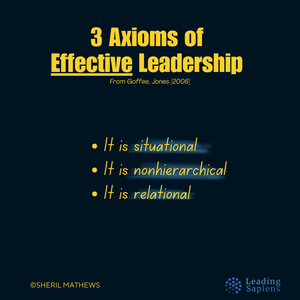
Instead of generic prescriptions, Goffee and Jones offer three leadership “axioms”.
Axioms by definition are self-evident — we intuitively know them from our own experience. The problem is that in the barrage of prescriptions, our own judgements and observations get lost and forgotten.
These axioms are also foundational — they are widely applicable, from the military and government to sports teams and businesses.
As you read them, notice how it confirms or clashes with your existing notions on leadership, organizations, and careers. Consider the implications. I follow it up with a set of reflection questions you can work with.
Axiom 1: Leadership is Situational
First, leadership is situational. What is required of the leader will always be influenced by the situation. This is commonsensical, but true.
History is full of examples of leaders who found their time and place, but whose qualities lost their appeal when things moved on. Winston Churchill, for example, was an inspirational wartime leader, but his bulldog style was ill suited to the reconstruction agenda of postwar Britain. Similarly, George Bush (senior) had a colossal opinion-poll lead in the immediate aftermath of the first Iraq war, and yet in the following year he lost to Bill Clinton. By contrast, Nelson Mandela’s ability to offer leadership across widely differing contexts exemplifies situational adjustment from a prison cell on Robben Island to the graceful lawns of Union House in Pretoria.
There are parallels in organizational life. For example, some hard-edged, cost-cutting turnaround managers are unable to offer leadership when there is a need to build. But their more adaptable colleagues adjust to shifting agendas—and carry their teams with them.
The ability to observe and understand existing situations, something we call situation sensing, is key to leadership. This involves a mixture of sensory and cognitive abilities. Effective leaders pick up important situational signals. They are able to tune in to the organizational frequency to understand what is going on beneath the surface. This is both a micro and a macro skill, visible in daily routine encounters (meetings, walking the corridors, elevator conversations) as well as in big, strategic decisions (Does this acquisition smell right? Are these good people to partner with?). Skillful leaders are then able to adjust appropriately, self-consciously deploying their personal capabilities, or leadership assets.
We do not mean to be excessively deterministic in our claim that leadership is situational. The situation, or context, the leader inherits is simply the starting point. Clearly, leaders’ actions themselves help to shape the context, altering the initial situation they found. In so doing, they are able to impact—and therefore reshape—the situations within which they lead. Through their interactions, effective leaders construct alternative contexts to those which they initially inherited.
What Goffee calls “situation sensing” is similar to what I call “leadership sensemaking”.
Axiom 2: Leadership is Nonhierarchical
This leads to our second observation: leadership is nonhierarchical. Much of the leadership literature is overly concerned with those who reach the top of organizations. In fact, we would go so far as to say that the persistent misconception that people who occupy senior organizational positions are leaders has probably damaged our capacity to understand leadership more than anything else. It has blinded us to the true nature of leadership.
While we recognize that there is a relationship between hierarchy and leadership (they may fulfill a similar function, for example, by investing authority), we view the relationship as contingent. Being given a particular organizational title—team leader, section head, and vice president—may confer some hierarchical authority, but it certainly does not make you a leader. Hierarchy alone is neither a necessary nor a sufficient condition for the exercise of leadership.
Indeed, it could be argued that the qualities that take you to the top of large-scale and often highly political organizations are not obviously the ones associated with leadership. People who make it to the top do so for a whole variety of reasons—including political acumen, personal ambition, time-serving, even nepotism— rather than real leadership quality.
Our interviews and experience inside organizations confirms that leadership is not the sole preserve of the chosen few. Great organizations have leaders at all levels. Some of the first work we did on leadership involved examining military organizations. Our assumption was that their hierarchical nature would make leadership development difficult. Nothing could be further from the truth. The best military organizations understand that when they move into action, they simply cannot rely on hierarchy; it may be obliterated when the first mortar lands. It is imperative that they develop leadership capability throughout. They do.
It is not just the military that has reached this realization. Consider Sonae, Portugal’s largest company… Sonae’s business stretches from wood veneers to telecommunications, taking in a huge retail operation. It focuses relentlessly on high performance—mediocrity is not tolerated. The company’s mission statement starkly states, “At Sonae you are either a leader or a candidate to be a leader.” The implication is clear; if you are neither, Sonae is not the place for you.
Successful organizations—be they hospitals, charities, or commercial enterprises—seek to build leadership capability widely and to give people the opportunity to exercise it.
Axiom 3: Leadership is Relational
The third foundation of our view of leadership is that leadership is relational. Put simply, you cannot be a leader without followers. Much of early trait theory seemed to ignore this. By trying to distill the characteristics of leaders, it neglected the fact that leadership is a relationship built actively by both parties.
In reality, leadership is always a social construct that is re-created by the relationships between leaders and those they aspire to lead. Effective leaders are not simply amalgams of desirable traits; they are actively and reciprocally engaged in a complex series of relationships that require cultivation and nurture. Like all social creations, this web of relationships is fragile and requires constant re-creation. You can confirm this every time you talk to a successful CEO, a sports coach, or a team leader. All will tell you that much of their leadership effort is devoted to the maintenance of particular kinds of relationships with their followers.
This insistence on the relational nature of leadership does not mean that these relationships are necessarily harmonious—they may well be edgy—but they are about leaders knowing how to excite followers to become great performers.
Does this mean generalizations are impossible? We don’t think so. Some fundamental principles of leadership do apply across the board. Followers want feelings of excitement and personal significance from their leaders—something confirmed by research. In addition, they wish to feel part of something bigger—a community, if you will. But above all, they look for leaders who are authentic. Indeed, authenticity is integral to the relationship. Without it, there can be no significant investment of trust on either side.
How leaders demonstrate authenticity—and how followers sense it—is a complex theme… For now, it is sufficient to note that, although this will involve different behaviors in different contexts, effective leaders are still able to communicate a consistent sense of self that is invested— skillfully—in each of the roles that they play.
Some questions for reflection
- What are some notions of leadership that you carry? Do they aid you or deter you? For more, see implicit leadership theories.
- Who are the managers/leaders you admire? Did they follow convention, or did they break it? How different were they from each other? See “best” leadership style.
- Do you wait for permission (hierarchy) to do what it takes?
- Are you looking for a simple formula?
- How important do you think leadership skill is for career progression? Is that accurate?
Related Reading
On leadership being situational:
- Why Netflix leads with Context, not Control
- Framing and psychological safety
- Leadership can be learned but can't be taught
On leadership being nonhierarchical:
On leadership being relational:
- Leading imperfectly and Congruence
- Role of self-disclosure in leadership
- Authenticity as knowing how your people get work done
Sources
- Goffee, Robert, and Gareth Jones. Why Should Anyone Be Led by You: What It Takes To Be An Authentic Leader.
- Homans, George. The Human Group.