

Consider a recent difficult experience at work. Perhaps it was a meeting where your idea was criticized, even dismissed. Or maybe a performance review that was less feedback and more an indictment. “Nothing personal, just business” they say. But it sure hurts.
How we process these frustrations fundamentally affects our disposition to future risk-taking and orientation to failure. So how do you “keep it business” and not take it personally?
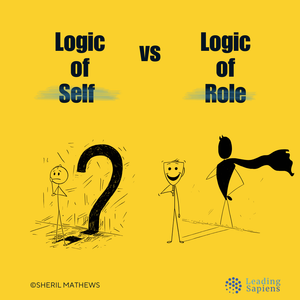
The trick is to discern between SELF vs. ROLE. It’s the ongoing practice of staying alert to “logic of person” vs “logic of situation”.
We take things personally because in critical moments, the boundary between who we are and what we do dissolves. But conflating the two is a trap and makes you more fragile.
👋 Get my new articles in your inbox 👇
Identity vs. Expectations
Logic of self is driven by long-held habits, personality, and needs—like the desire to be liked or the fear of being judged. It’s what we subjectively consider as our "authentic" self; the internal script we’ve been writing since childhood.
In contrast, a role is the set of expectations that a social system—like an organization—places on us to provide specific services. Logic of role is driven by the expectations of those around us, defined by what the context, situation, and social norms require.
One focuses on "Who am I?”. The other on "What does this role or situation require of me right now?"
The trouble starts when we allow our professional persona to exclusively define who we are.
The world actively colludes to make you forget this distinction. Bosses, subordinates, and stakeholders treat you as if the role you play is the core of your identity. They don't see you per se; they see a reflection of their own needs, worries, or hopes for a fix to their problems.
Staying alert to this distinction is vital for stability. If you understand that people are reacting to your role and the issues you represent, you gain control over whether your self-worth is at stake. Without this clarity, we become a hostage to professional conflict.
Consequences of confusing the two
One cause of professional burnout is failing to distinguish between the two logics, become we become highly vulnerable to external ups and downs. By taking things personally, we spend energy on personal defense instead of moving issues forward.
It’s also a prison. Logic of self suggests "being yourself” as an unchanging collection of traits. This means deviating from habitual behaviors is to “fake it”. When the going gets tough, it’s easy to retreat into "I can't. That's just not me”. We fail to recognize that the self is a work in progress, not a finished product.
Imposter syndrome is a logical extension of this. It’s the fear of revealing the gap between the actor and the role when we are thrust into something for which we do not feel fully equipped. We fear being seen through, like the Wizard of Oz. However, this anxiety is usually a sign that we’re too focused on the "self" and not enough on the "role."
When leaders feel powerless or out of touch with circumstances, it’s because of too much Logic of Person that makes them self-protective. Conversely, lasting power comes from doing what’s best for the group, even when that feels "inauthentic" to your personal needs.
It's easy to lose sight of the goal when internal weather — fears, insecurities, and needs — overwhelms our commitment to the role. A manager who is too friendly and hands-off because they want to be liked is failing to play the role of the responsible boss. They’ve allowed the logic of self (the need for approval) to override the logic of role (the team’s need for structure).
Keeping the two separate
Given the criticality of keeping role and self separate to effectiveness and longevity, below are some practices and stances.
The direction of gaze. Logic of Self is inward-looking and self-protective, while Logic of Role is outward-looking and group-oriented. Being effective means moving away from our own struggles—and instead track who we are to others.
You’re the focal point, not a target. Workplace dynamics are like a soccer match. When the opposing team tackles you, they aren't doing it because they hate you personally, but because you have the ball. A professional athlete doesn't stop to ask, "Why don't they like me?" They understand the conditions of the game. In leadership, you’re the one "carrying the ball". When you raise a difficult question or challenge a long-held norm, you become the focal point for the distress that the challenge generates. People might call you out, block your way, and attack your style. It feels personal, but it’s rarely about you. Instead, it’s the threat your perspective poses to their habits, loyalties, and ways of thinking.
Manage the self as a system. Practice seeing yourself not as a single, static "self," but as a complex "system" of multiple identities. You are a parent, a spouse, a professional, a friend, and a mentor. Each of these roles is authentically you, but none of them is the whole you. This systemic view allows you to maintain perspective even in choppy waters.
“Be authentic” can be a trap. We’re often told to “be yourself”. But this can also be a recipe for staying stuck in the past. If we only do what feels "natural," we are merely repeating habits and staying within comfort zones. Professional growth requires us to stretch beyond what feels safe and do what’s required for the stage we are on. True authenticity comes from learning to accept more of yourself—including the messy, insecure parts—and choosing which characters to bring onto the stage at the right time. Build a responsive “behavioral repertoire” instead of a “dominant style” that reacts.
Think beneficence, not dominance. Understanding your role as a "steward" rather than a "ruler" recognizes that authority is a gift given by the group to achieve collective goals. This requires the maturity to take the heat, share the spotlight, and put the group first even when it feels counter to our personal desire for recognition. In the long run, beneficence is a lot more durable.
Everything is a performance. Distinguishing self from role is not about being "fake" but committing to what the situation needs, even when it feels “inauthentic”. Understanding that you're always performing allows you to stop worrying about whether your professional behavior is "the real me" and start focusing instead on whether it is "the responsible me". In this sense, acting is a disciplined practice of managing the noisy parts of our internal life so that the useful parts can do the work.
Move the heat from person to purpose. Maintaining the self/role distinction allows you to externalize conflict. By internalizing conflict, we make it a personal problem, leading to a misdiagnosis of the situation. We start defending our character instead of focusing on the issue. The job is to keep the work as the center of attention, not you.
Build a balanced portfolio of meaning. If you define life through a single endeavor, you become vulnerable when the environment changes or the role ends. We find meaning by connecting with others. This can happen in the office, but it happens just as profoundly with family, in communities, and through hobbies. Once you realize that the form of contribution doesn't matter, you gain a massive advantage: the freedom to fail. When self-worth is anchored in a variety of places, we can take bigger risks professionally because you know that even in failure, the "self" remains vital, anchored, and capable of finding new forms of service.
Power as a part, not possession. A common fallacy in leadership is the "cult of personality"—the notion that power comes from charisma or ambition. In reality, power is social; it lives and dies in context. It’s relevant only to the extent to which others need you. If a project fails or a client leaves, it isn't a verdict on you, but a failed movement in a complex drama. This distance allows for skilled self-reflection where you can analyze your "performance” objectively.
Distinguishing self from role is a fundamental skill. It provides the psychological distance to handle criticism, the flexibility to stay adaptive, and the humility to serve something higher than self-aggrandizement.
Through the practice of discerning between the two, we create more capacity for action.
Related reading
 Sheril Mathews
 Sheril Mathews
 Sheril Mathews
Sources and references
- Deborah Gruenfeld, Acting with Power.
- Ronald Heifetz, Alexander Grashow, and Marty Linsky. The Practice of Adaptive Leadership.
- Ronald Heifetz. Leadership Without Easy Answers.
- Miguel Pina Cunha, Stewart R. Clegg, Arménio Rego, and Marco Berti. Paradoxes of Power and Leadership.